Holiday Season Is Ripe for Scams. AI Is Making Them Harder to Spot
November 16, 2026
Holiday Season Is Ripe for Scams. AI Is Making Them Harder to Spot
Social media scams get a lot of headlines. For people 60 and older, though, the call that comes in on your phone is still the one most likely to take a large bite out of your savings.
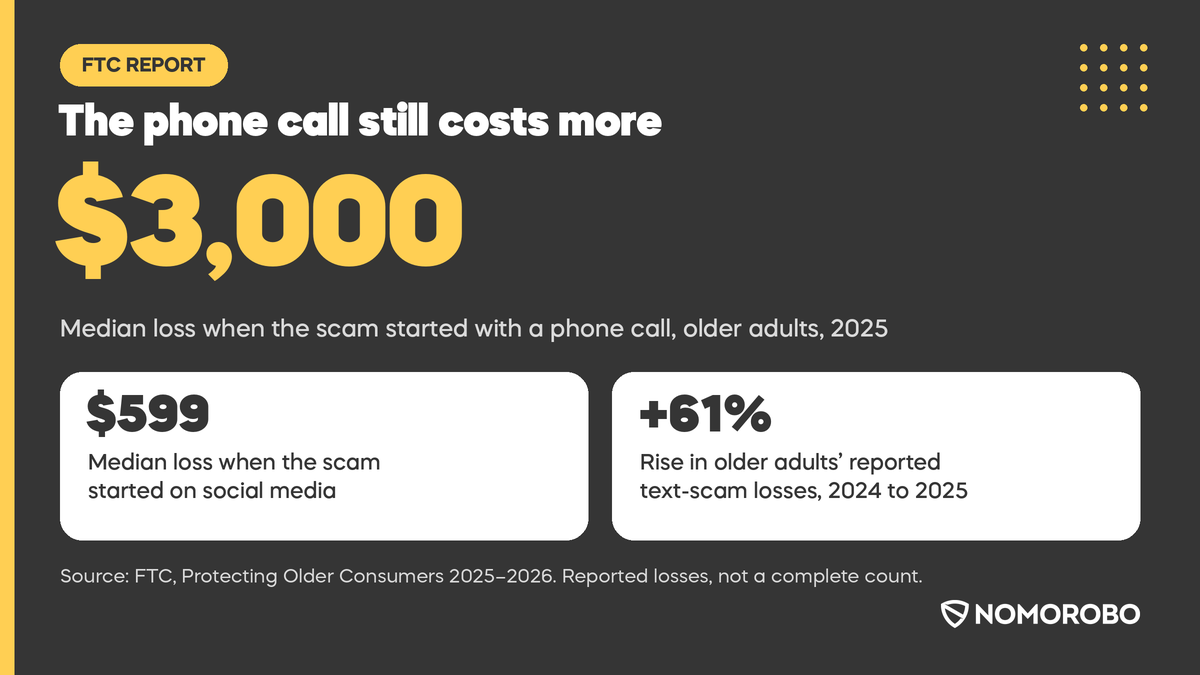
That’s one of the clearest findings in the Federal Trade Commission’s October 19, 2026 report, Protecting Older Consumers 2025 - 2026. Older adults reported losing more money in total to scams that started on social media. The typical loss was far higher when the scam started with a phone call: a median of $3,000, compared with $599 for fraud that began on social media.
For people 80 and over, the phone isn’t even close. In 2025, that age group reported much higher losses, and filed far more loss reports, on scams that started with a phone call than on any other method of contact. Social media was a distant second.
The dollar figures behind the warning
In 2025, people 60 and older reported losing more than $3 billion to fraud, up from about $2.4 billion in 2024 and about $600 million in 2020. About 123,000 of their reports included a monetary loss.
Those totals are only what people reported. The FTC notes that most fraud is never reported to the government, so the real harm is almost certainly larger.
Two other numbers are worth sitting with:
- Reported text-scam losses by older adults rose 61% from 2024 to 2025.
- Among older adults who filed a fraud report but did not lose money, the largest shares were about text scams (32%) and scams that started with a phone call (29%).
In other words, a lot of people are spotting these pitches and hanging up. The ones who do lose money often lose a lot.
What those phone scams sound like
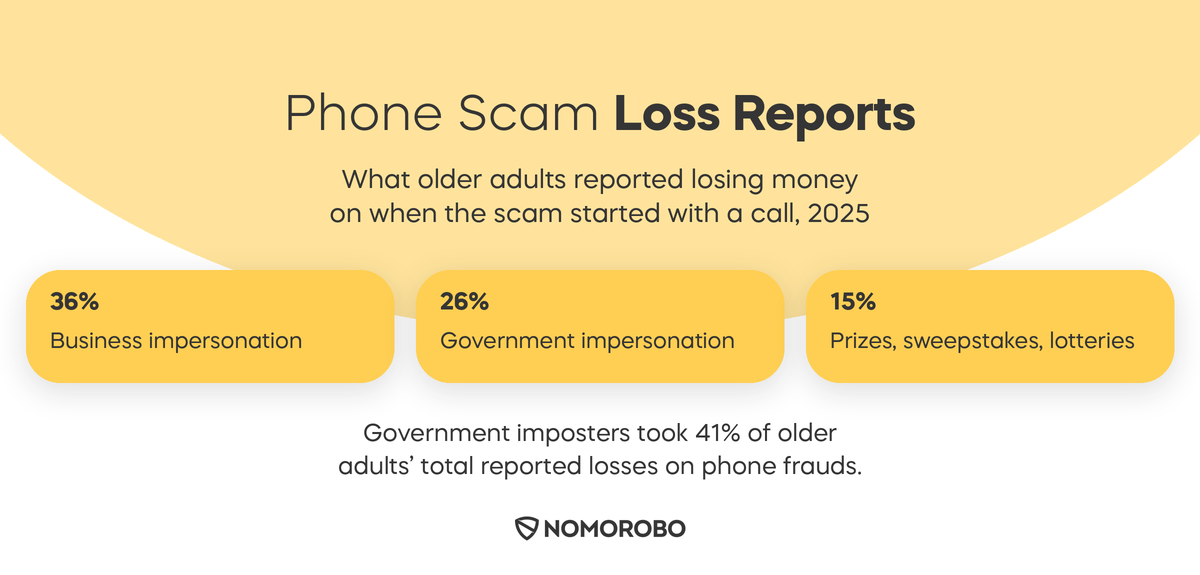
When a phone call was how the scam first reached them, older adults most often reported losing money on:
- Business-impersonation scams (36%)
- Government-impersonation scams (26%)
- Prize, sweepstakes and lottery scams (15%)
Government imposters accounted for 41% of older adults’ total reported losses on phone frauds. That gap between “how often” and “how much” is the point. A fake prize call is common. A caller posing as a government agency is the one more likely to walk away with a life-changing sum.
The business impersonators are often just as serious. The report says the highest total losses in that category were on scams impersonating banks. The pitch is usually that a security problem has put your accounts at risk, and that you need to move your money to keep it “safe.” We’ve written about how that sounds in real life, including a fake Bank of America fraud call that urges you to press 1 before you can check anything.
Medicare shows up in this data too. Among older adults who reported a phone scam but did not lose money, the callers often claimed to be from Medicare, banks, Amazon or the FTC. That’s the same pressure you hear in Medicare “expiration” and benefits pitches: your coverage is at risk, unless you stay on the line.
What the text scams look like
The text side of this story has a familiar shape. The largest share of older adults’ text-scam loss reports (31%) were about messages impersonating well-known businesses, especially Amazon, Apple and banks. These texts often look like account security alerts about suspicious activity or unauthorized purchases.
Among older adults who reported a scam but did not lose money, the texts they flagged were often posing as state motor-vehicle offices or toll-road operators.
If a text warns you about a charge, a package, a toll or a license, and asks you to tap a link or call a number in the message, treat that as a warning sign, not a to-do list.
What to do if you get one of these calls or texts
A real bank, a real government agency and a real company will not mind if you hang up and check. A scammer will.
- Let unknown numbers go to voicemail. If it matters, the caller can leave a message, and you can decide what to do next.
- Hang up on urgency. “Your account is frozen,” “your benefits will stop” and “you must act now” are pressure lines, not proof.
- Call back on a number you already trust. Use the number on your bank statement, your Medicare card or the agency’s official website. Do not use a number from the call, the text or a link in the message.
- Do not “confirm” your information. A caller who already “has your file” should not need you to read back a Social Security number, a Medicare number or a one-time passcode.
- Do not move money to keep it safe. A real bank will not ask you to transfer funds, mail cash, buy gift cards or deposit cash at a Bitcoin ATM.
- Report it. Tell the FTC at ReportFraud.ftc.gov, even if you hung up in time. Those reports are how the agency tracks these schemes.
If a message still has you wondering, paste it into Nomorobo’s Scam Detector before you reply. A service such as Nomorobo can also help block a lot of these calls and texts before your phone ever rings.
The FTC report is a reminder, not a reason to panic. Older adults already catch a large share of these scams before any money goes out the door. The goal is to make the expensive ones as easy to hang up on as the obvious ones.